.

Bladder Care and Urinary Health

Your pet’s bladder must be completely expressed at least three times daily! All mobility-impaired pets are susceptible to “pooling” or “partial urine retention”. Often when you find your pet’s bedding wet it does not mean that it is urinating on its own but rather that the bladder has become so full that there is an overflow.

Cystitis or bladder infection is the greatest threat to your pet’s health following nerve injury to the rear quarters. Such infections are very serious and could lead to death in a matter of days if left untreated. This is true whether your pet is totally down, partially down, partially walking or completely walking. Preventative bladder care plays a crucial part in the health of your pet, whether is has surgery or not.

Signs of a Urinary Tract Infection Include:

1. Dribbling or urine evidence, by soaking of the rear quarters and bedding
2. Foul Odor to urine and increased licking of the genital area as infection worsens
3. Bloody or dark colored urine-severe symptom requires immediate veterinary care!
4. Depression, loss of appetite, rise in temperature as infection progresses

Treatment of Urinary Tract Infection

Due to the insidious nature and frequency of this type of infection, prophylactic medical treatment before signs of infection occur offers the best route of treatment. The co-operation of your veterinarian in prescribing the best medication, monitoring PH and culturing the urine, and providing instruction on expression or clearing of the bladder of pooled urine is essential for successful nursing care. Urine retained in the bladder can become a culture media for bacterial growth.

Following are instructions on how to manually express your pet’s bladder but ASK YOUR VETERINARIAN TO SHOW YOU HOW. A demonstration is always the best way to understand this sort of procedure.

How To Express your Pet's Bladder

Smaller pets are easily managed by one person. Larger pets may require two people or in the case of extremely obese pets you may not be able to manage it but have to have your veterinarian take care of it for you.

Support your pet in an upright position
Take your left hand and place it on the small of your pet’s back (reverse if left handed)
Take your right hand and feel where the ribs end on the abdomen. Your thumb should be on one side of the abdomen and your four fingers on the other side
GENTLY SQUEEZE your thumb and four fingers together and while holding that position, move hand towards rear of abdomen. A full bladder should feel like an inflated balloon
Urine should be released in a fairly steady stream and when urine decreases to a dribble, the bladder has been sufficiently expressed
If Urine is squirting out or you feel some resistance and the urine does not stream out, then you pet is starting to have bladder control
An alternative method of expressing the bladder on small pets is to place one hand on either side of the pet’s side behind the rib cage and gently squeeze hands together

NOTE: The bladder must be manually expressed until your pet is able to fully urinate on its own. Having the bladder expressed at least three times daily is a permanent nursing care necessity for permanently impaired pets.

Bladder Care is often a long-term nursing care need for months or years. The success of your nursing care program will hinge on how effective you become in this care.

DEFECATION
Defecation is a more reflexive action requiring minimal or no assistance.

ELIMINATION AIDS

DIAPERS

FEMALES - We have Female Diapers in many sizes and colors. With the addition of a sanitary pad, they catch urine and feces. However, if you use them for the purpose of feces, then you will probably have to clean off your pet’s rear, as well as the diaper.

MALES - We have
MALE WRAPS for urinary incontinence. They wrap over the penis and with the insertion of a sanitary pad and takes care of any dribbling. They come in many sizes and colors.

CATCH-IT-ALL We designed Catch-It-All for pets up to 45lbs for use in the home to attach to the back of the cart, to catch feces and in the case of female pets, urine with the insertion of a sanitary pad.

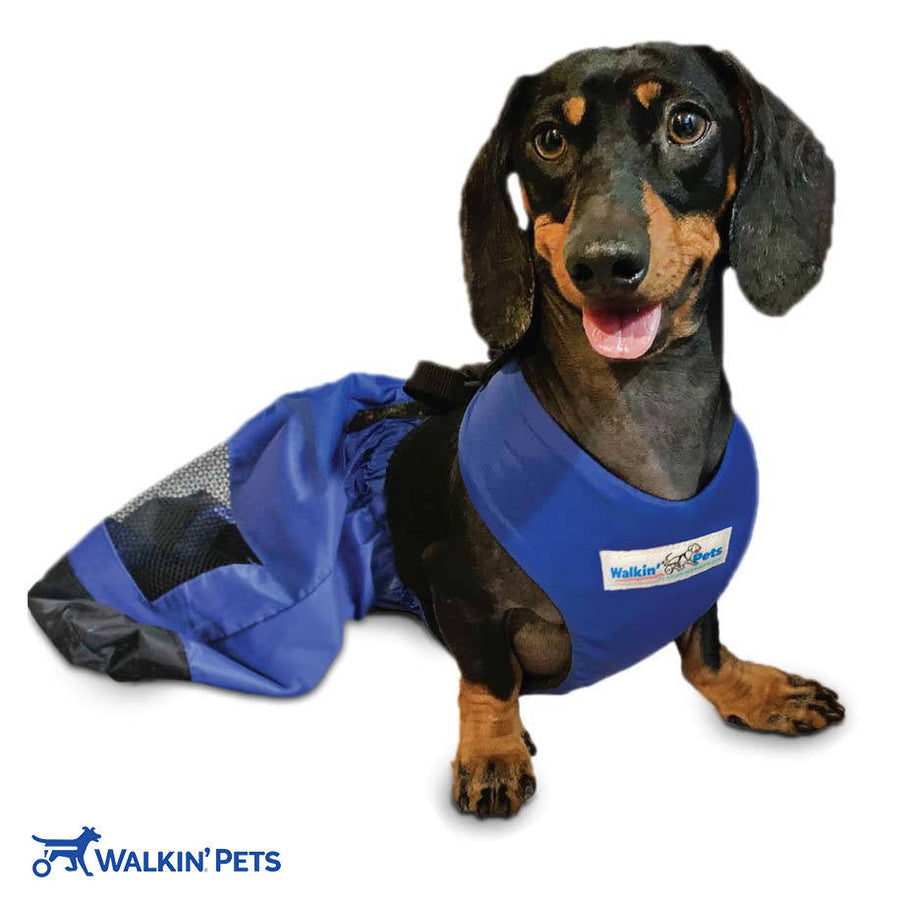
PROTECT-A-PET We designed Protect-A-Pet for small pets for use in the home, when they are not in their carts. It both helps to prevent urine infections and pressure sores and keeps your home and bedding clean.

back to top

Proper Bedding

Confining your pet to an area where there is plentiful clean, soft bedding is crucial for your pet’s recovery. If given a choice, your pet will choose a hard cool surface on which to rest instead of a soft padded area and Decubital (pressure) sores will develop.

WE RECOMMEND:

1. Confining your pet to an enclosed area depending on your pet and your home’s size. I have a Dachshund and when he is not in his cart I keep him in a play pen with his bed wrapped in plastic and then covered with towels. This way all I need do is take out the towels each morning and wash them. With his PROTECT-A-PET it makes clean-up very easy. Of course since urine and feces were contained in his Protect-a-pet I then have to give him a quick bath before putting him in his cart.

2. If you have a large dog, we strongly recommend the Canine Cooler Water Bed. It is a bed containing soft cushioned foam encased in a strong plastic cover. It need only be filled once is warranted against any defects or tears for 2 years other than chewing and best of all it maintains a cool temperature. This is ideal for pets that get hot easily and seek out a cool surface on which to lie. Cool surfaces are often hard surfaces and when you have a pet that is mobility-impaired they are very susceptible to pressure sores and hygromas (elbow sores).

3. For the pet that needs a warm bed, the addition of a heater under the water bed maintains a safe heated bed. My Dachshund lives on his when he is not in his regular bed. He just rests his front end on it and goes to sleep!

4. Do not allow your pet to lie on one side continually. Turn it over regularly. For pets with fore limb weakness or rear limb problems sometimes it is better to prop them up in sternal recumbency using rolled up blankets on either side of their body and their head resting on a rolled up towel.

5. Remember-allowing your pet to drag around over any hard surface will cause pressure sores and once established, these sores are difficult to heal. Be particularly watchful with long-haired pets as the sores may be hidden in the coat.

back to top

Regular Bathing

Bathing will prevent sores by maintaining the hair, coat and skin in a healthy condition. The rear quarters of your pet must be gently bathed at least once daily with warm water and a soft clean wash cloth. If your pet has an excessive amount of hair, you may want to clip the rear of your pet for sanitary reasons and ease of keeping the area clean. The larger the dog, the more difficult it is to prevent pressure sores. For larger, heavier pets, bathing at least once, preferably twice daily is truly crucial to keeping the skin clean and healthy. Pets should be checked carefully daily as pressure sores can hide under hair- watch for pets that tend always to lie on one side and on areas such as the hips and elbows. Larger pets take more time and more care to heal should they incur sores therefore prevention is the answer.

PRESSURE SORES
Pressure sores can be extremely serious if not caught in time and can open right down to the bone. Your Veterinarian will advise you as to how to take care of it after it is clipped of all hair and cleaned.

back to top

Physical Therapy

PHYSICAL THERAPY

Physical therapy together with a good nursing care program is very often instrumental in bringing a pet back to walking independently. There are excellent Rehabilitation Centers available for pets. Check out our links- we are now a proud sponsor of rehabilitation centers all across the country. Or ask your veterinarian if there is one in your area.

The therapy you are able to provide will depend on the size of your pet, what your pet will tolerate and the time and finances you have available. Not all of the following suggestions will pertain to all pets or all conditions.

NOTE: If you determine after looking at our Evaluation Page that your pet is a candidate for a cart, we cannot emphasize enough as to the therapeutic value of placing your pet in a K-9 Cart. After 40 years of providing carts for mobility-impaired pets there is absolutely no question that K-9 Carts encourage pets to return to walking independently and if they have a condition where that is not feasible then the cart will give your pet a greatly improved quality of life and make nursing care easier for you the owner.

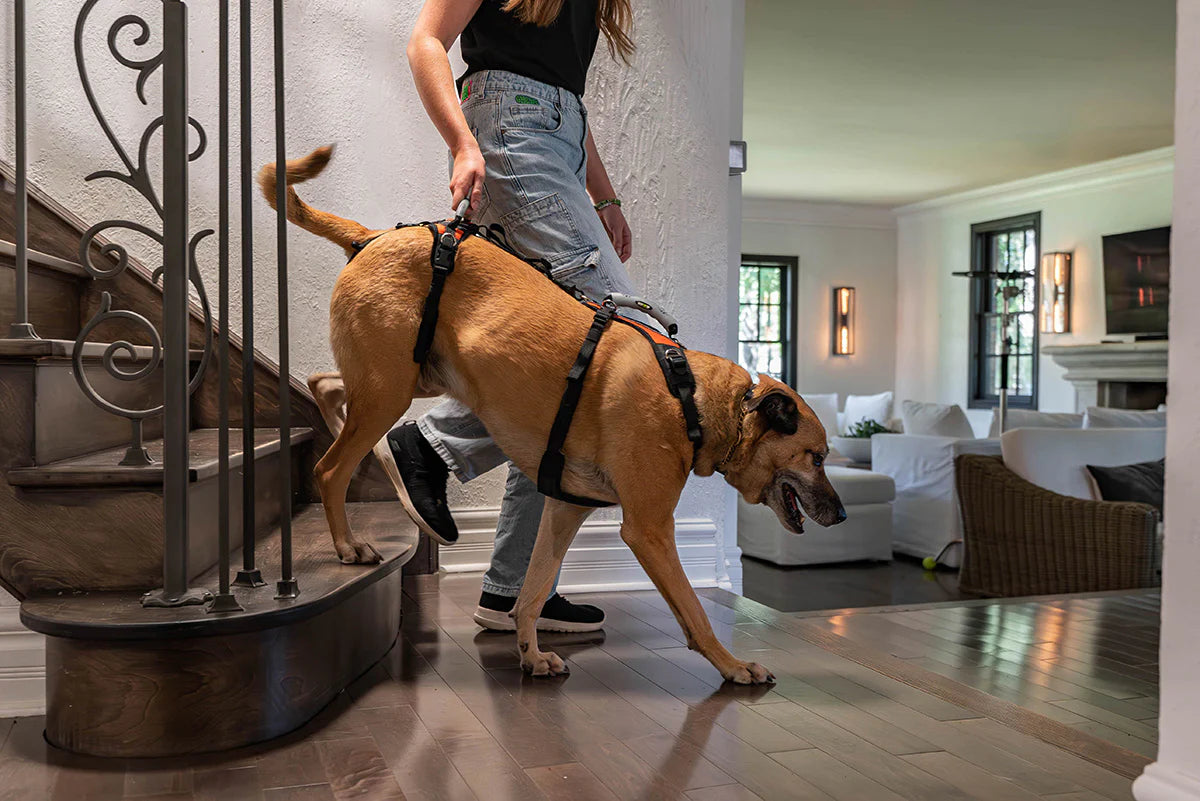
Swimming is an excellent form of physical therapy! If you have a pool, then take your pet in the pool with you. Life jackets are available from many pet and marine stores if you feel they are necessary. Our Walkabout Harness have handles and are helpful in supporting pets while swimming them. All Rehabilitation Centers have pools.

FLOTATION BATHS

This is ideal for the small pet. Fill your bathtub with warm water, deep enough so that your pet’s feet are off the bottom of the tub. Support the rear of your pet and let them swim with the front legs. Baths help keep the skin clean and healthy and very often pets, like people, are able to move more in water than on ground. Swimming has the added benefit of helping with weight loss in an obese pet.

NOTE: SWIMMING IS NOT A GOOD IDEA IF YOUR PET HATES OR IS AFRAID OF WATER!
Check first with your veterinarian to ensure that your pet’s hips and knees are not dislocated before attempting to do the following!

It is important that your pet retain normal range of motion in the limbs, so that they do not become rigid and the joints immovable or frozen.

Never allow pets to scoot around on their bottoms with their rear legs out at a 45 degree angle, as this behavior may preclude return to normal function should they regain feeling in the their legs! Dragging around in this manner will particularly affect the hips and knees. Two examples of cases where you find rigid limbs are spinal fractures in any breed and Wobbler’s syndrome in Dobermans.

When doing range of motion exercises, place the pet on its side and with the paw flat on your hand, move the leg up and down towards the hip. You may want to keep one hand on the knee of a larger pet or on the hip if a smaller pet. Then turn the pet over and repeat with the other leg. Although your pet may have no feeling in its legs, doing this daily will help ensure that if and when feeling does return, the joints will be flexible.

back to top

Rabbits

Rabbits do extremely well in carts, especially if they have no use of the rear limbs. We do use a special leg support system, as they have such long rear legs. If they have minimal use or use of one hind leg, then the appropriate changes to the cart design are made. We usually suggest that you purchase a small harness that fits around the rabbit’s front (like those used for walking pets). Additional measurements required for making a cart are the height of your rabbit, both front and back, taken in a crouched position. You may wish to place the addition of a Catch-It-All on the cart, as this will help keep both the rabbit and your home clean. If your Rabbit has a rear limb deformity or any other unusual physical problem, we will need to see a video of what it does on its own and with sling support under the rear limbs.

back to top

Other Pets

Over the past 40years, we have made up carts for a variety of other animals including, sheep, goats, skunks, ferrets, possums, deer, miniature horses and even suggested designs for owners to make up their own support for rats, hamsters and a monitor lizard! We love challenges and are always here to help and suggest.

A Video of the pet showing its ability as to what it can do on its own and with sling support, is very helpful.

back to top